
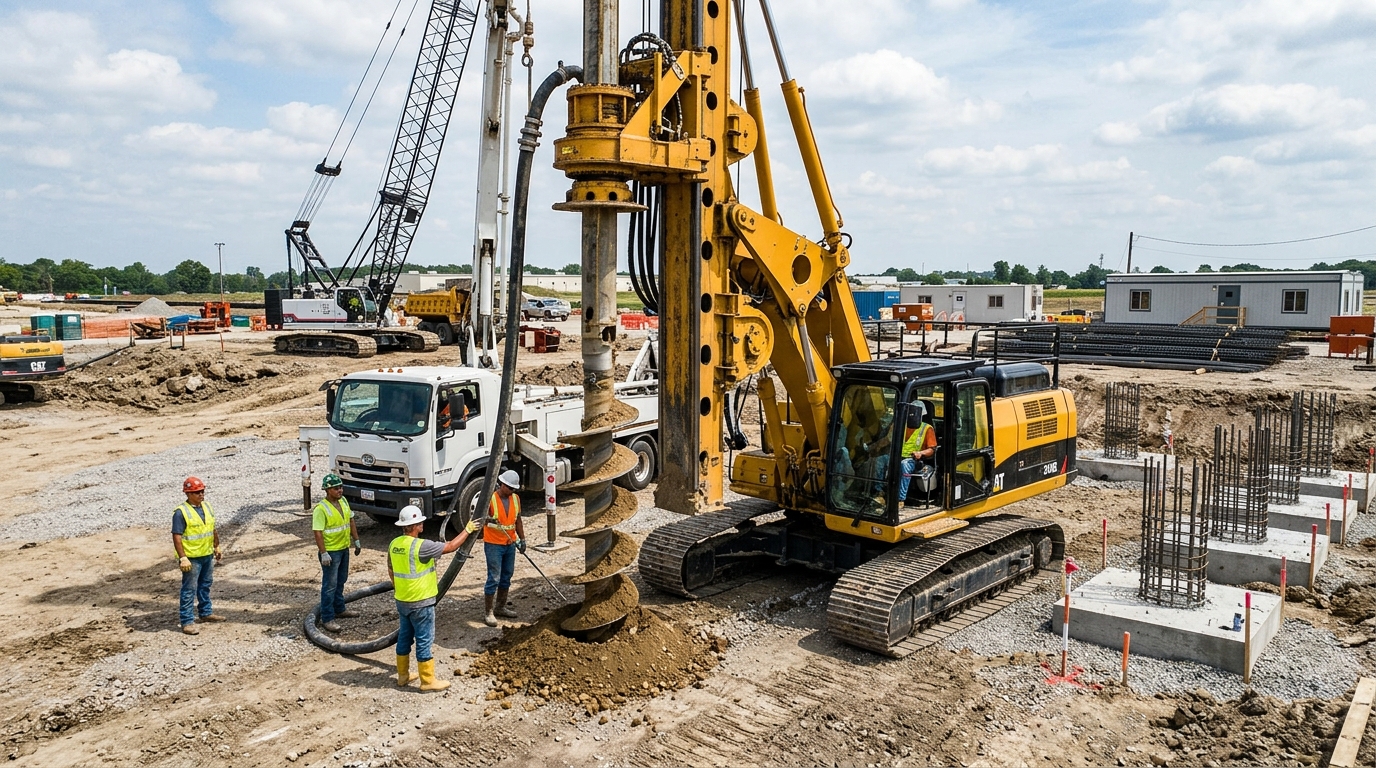
CFA piling is a widely used foundation technique in the construction industry, known for its efficiency, strength, and minimal environmental impact. It is commonly used for residential, commercial, and infrastructure projects where strong and stable foundations are required.
The method provides excellent load-bearing capacity while reducing noise and vibration during installation, making it suitable for a variety of ground conditions.
What Is CFA Piling
CFA piling stands for Continuous Flight Auger piling. It is a foundation system where a hollow-stem auger is drilled into the ground to the required depth, and concrete is pumped through the stem as the auger is withdrawn. Reinforcement cages are then inserted into the concrete-filled pile.
This process creates strong and durable foundations capable of supporting heavy structures.
How CFA Piling Works
The CFA piling process involves several key steps.
- Drilling the auger into the ground to the designed depth
- Pumping concrete through the hollow stem while removing the auger
- Inserting reinforcement cages into the freshly placed concrete
- Allowing the pile to cure and gain strength
The method is efficient and reduces disruption to surrounding areas.
Benefits of CFA Piling
CFA piling offers multiple advantages for construction projects.
- Suitable for a wide range of soil conditions
- Reduced noise and vibration during installation
- Faster installation compared to some traditional methods
- High load-bearing capacity
- Minimal ground disturbance
These benefits make it a preferred choice for many projects.
Common Applications of CFA Piling
CFA piling is used across various types of construction.
- Residential developments
- Commercial buildings
- Industrial facilities
- Retaining wall support
- Infrastructure and bridge projects
Its versatility allows it to be used in both small and large-scale developments.
Why CFA Piling Is Popular in Urban Areas
One major advantage of CFA piling is its suitability for built-up environments.
- Lower vibration reduces impact on nearby structures
- Minimal noise compared to driven piling systems
- Faster installation helps reduce project timelines
- Cleaner and more controlled construction process
These factors make it ideal for urban and restricted-access sites.
Importance of Soil Investigation
Before starting CFA piling, proper site investigation is essential.
- Determines soil conditions and load requirements
- Identifies groundwater levels
- Helps engineers design the appropriate pile depth and diameter
- Reduces the risk of foundation failure
Accurate soil analysis ensures the success of the piling system.
Factors Affecting CFA Piling Design
Several factors influence the design and performance of CFA piles.
- Soil type and ground stability
- Structural load requirements
- Pile diameter and depth
- Reinforcement specifications
- Environmental and site conditions
Engineering expertise is essential for proper planning and execution.
Maintenance and Long-Term Performance
CFA piles are designed for long-term durability and stability.
- Resistant to settlement when properly installed
- Suitable for heavy structural loads
- Requires minimal maintenance after construction
Quality workmanship and proper engineering contribute to long-lasting performance.
Common Questions About CFA Piling
Is CFA piling suitable for all soil types
It works well in many soil conditions but requires proper engineering assessment
How deep can CFA piles go
Depth varies depending on project requirements and soil conditions
Is CFA piling environmentally friendly
Yes, it produces less noise and vibration compared to some other piling methods
Final Thoughts
CFA piling is a highly effective and reliable foundation solution for modern construction projects. Its efficiency, strength, and adaptability make it suitable for a wide range of applications, from residential buildings to large infrastructure developments.
With proper planning, engineering, and installation, CFA piling provides durable and stable foundations that support long-term structural performance.




