
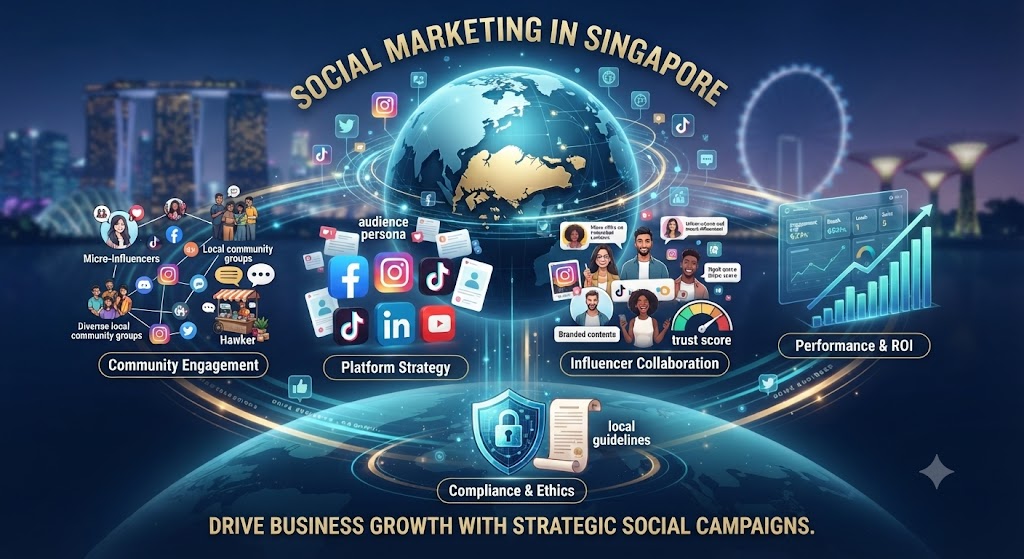
A business presence on social media and a social marketing strategy are two very different things. Many Singapore businesses maintain active social accounts without those accounts contributing meaningfully to their commercial objectives. The difference between the two lies in intentionality, audience understanding, and the ability to connect content output to business outcomes rather than simply generating activity. Social marketing in Singapore done well is one of the most effective ways to build brand awareness, nurture customer relationships, and drive enquiries in a market where social media are recognised as some of the highest globally.
The Singapore Social Media Landscape
Singapore’s population is highly connected, mobile-first, and engaged across multiple platforms simultaneously. Facebook, Instagram, TikTok, LinkedIn, and YouTube all have significant active user bases in Singapore, with the dominant platform varying considerably by audience demographic and industry sector.
Understanding which platforms are actually used by a business’s target audience is the foundational step in social marketing strategy, and it is one that many businesses skip in favour of maintaining a presence everywhere at once. Being spread across six platforms with mediocre content on each produces far less business impact than focusing on two or three platforms where the target audience is genuinely active and where the content format suits the business’s strengths.
What Effective Social Content Looks Like in This Market
Singapore audiences are sophisticated and spend significant time on social platforms, which means they are highly attuned to content that feels generic, templated, or created without genuine understanding of their interests and needs. Content that performs well in this market tends to be specific, useful, visually considered, and either locally relevant or genuinely globally applicable rather than occupying the undifferentiated middle ground.
For B2B businesses, LinkedIn is a particularly strong channel in Singapore given the professional density of the market and the high usage rate among senior decision-makers. Content that demonstrates expertise, shares genuine insight, and engages with current industry conversations consistently outperforms promotional content that leads with product or service messaging.
For consumer-facing businesses, Instagram and TikTok reward visual quality, authenticity, and the ability to tap into cultural moments and trends in a way that feels natural rather than calculated. User-generated content, behind-the-scenes storytelling, and content that sparks genuine engagement through questions or interactive formats all tend to outperform static promotional posts.
Paid Social and the Importance of Getting the Targeting Right
Organic reach on most social platforms has declined significantly over the past several years as platforms have prioritised paid distribution. For businesses serious about social marketing in Singapore, paid social advertising is not optional — it is the mechanism that ensures content reaches beyond the existing follower base and gets in front of the audiences most likely to become customers.
The effectiveness of paid social in Singapore depends heavily on how precisely the audience is defined. Singapore’s compact geography and highly specific demographic and psychographic segments mean that well-targeted campaigns can reach a very high proportion of a defined audience efficiently. Poorly targeted campaigns burn budget reaching users who have no relevance to the business’s offering, producing low engagement rates and poor return on advertising spend.
Measuring What Actually Matters
One of the most common weaknesses in social marketing programmes is measuring the wrong things. Follower counts, likes, and reach are easy to report and are often used as the primary indicators of social media success. But none of these metrics directly reflects business impact. The metrics that matter are those that connect social activity to commercial outcomes, including website traffic from social channels, lead form completions, direct messages or enquiries attributed to social content, and where tracking allows, revenue influenced by social touchpoints in the customer journey.
Establishing measurement frameworks that capture these downstream indicators at the outset of a social marketing programme is what allows honest evaluation of whether the investment in content creation and paid distribution is producing a return worth continuing.
Building a Social Marketing Approach That Lasts
Social marketing in Singapore is not a short-term tactic that produces immediate results and can be switched off. It is a sustained programme of audience building, content development, and relationship maintenance that compounds in value over time as the brand’s social presence becomes more established and its content reaches an increasingly engaged audience.
For Singapore businesses investing in this space, working with a team or agency that understands the local market, the platform dynamics relevant to the specific industry, and the measurement frameworks that connect social activity to business goals is what distinguishes a social marketing in Singapore programme that genuinely contributes to growth from one that generates activity without impact.




