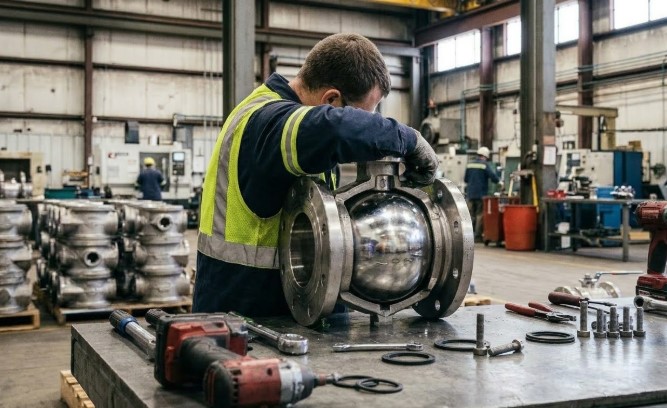
Industrial process loops running through high-pressure, high-temperature, and corrosive environments demand severe service isolation valves with robust mechanical integrity. Standard cast components can sometimes harbor microscopic porosity or internal grain structure voids that compromise structural durability under extreme stress. Forged ball valves eliminate these vulnerabilities through high-pressure mechanical forming, delivering uniform grain flow, superior strength, and reliable leak-tight shut-off across critical process operations.
Mechanical Advantages of Forged Ball Valve Construction
Forged ball valves are engineered for severe process applications where pressure integrity, fire safety, and long service life are essential. Utilizing 2-piece and 3-piece forged body designs, these valves provide structural density and grain alignment that withstand high mechanical stress and pressure surges.
A fundamental safety feature is the blow-out proof stem design, which prevents stem ejection under elevated internal pressure. Fire-safe and anti-static features compliant with API 607, API 6FA, BS 6755 Part II, and BS EN ISO 10497 ensure that in the event of a fire, secondary metal-to-metal sealing takes effect after primary soft seals decompose, maintaining absolute fire-safe isolation. Additionally, triple stem sealing arrangements—comprising double O-rings and top graphite seals—prevent atmospheric emissions.
Design Configurations: Floating and Trunnion Mounted Ball Valves
Forged ball valves are manufactured in both floating ball and trunnion mounted configurations to match specific pipeline dynamics and pressure ratings:
In floating ball valve configurations, the ball is suspended within spring-loaded seats. Line pressure forces the ball against the downstream seat to create a positive tight shut-off. This design provides dependable isolation for small-to-medium bore sizes across various pressure classes.
In trunnion mounted ball valve configurations, the ball is anchored top and bottom by trunnion stems, allowing the seats to float against the ball. Spring-loaded floating seats maintain continuous contact even at low differential pressures, facilitating independent upstream and downstream sealing. This design enables double block and bleed operation, permitting operators to drain trapped fluid from the body cavity safely while the pipeline remains pressurized.
Pressure Ratings, Sizes, and Material Specifications
Forged ball valves cover an extensive operational envelope, supporting pressure ratings from ASME Class 150# to Class 250# and service temperatures ranging from -46°C to +538°C in sizes from 1/2 inch to 24 inches. Both full bore and reduced bore options are available to optimize flow capacity or velocity requirements.
Material selection is governed by process media parameters: Carbon steel forging options include ASTM A105 for standard service and ASTM A350 LF2 for low-temperature service. Stainless steel forgings comprise ASTM A182 F304 and F316 grades. Severe media and sour service loops utilize Duplex and Super Duplex forged steels (ASTM A182 F51 / F53) alongside Alloy Steel (ASTM A217 WC6 / WC9) and Monel, Hastelloy, or Inconel on request. All body and trim materials are offered fully compliant with NACE MR0175 standards for hydrogen sulfide environments.
Primary Industrial Applications
Forged ball valves provide critical isolation across heavy processing sectors:
In oil and gas transmission pipelines and offshore platforms, they provide secure line isolation, pigging manifold control, and double block and bleed draining under severe pressure cycles.
In chemical and petrochemical plants, they handle aggressive hydrocarbons, solvents, and corrosive gases while resisting thermal shock and fugitive emissions.
In power generation facilities, they manage high-pressure steam lines, boiler feed loops, and cooling water circuits.
In petroleum refineries, they regulate high-temperature thermal fluids, catalytic cracking loops, and hydrogen processing units.
In water treatment and industrial distribution networks, they ensure reliable flow control with manual, gear, pneumatic, or electric actuation options.
Design Standards and Quality Testing
Every valve body and trim is designed and manufactured in strict compliance with ASME B16.34, API 6D, and BS EN ISO 17292 specifications covering shell thickness, face-to-face dimensions (ASME B16.10), and flange dimensions (ASME B16.5 / B16.47).
Strict manufacturing adherence under rigid quality controlled procedures approved to ISO 9001:2015 guarantees critical dimensional tolerances, surface finishes, and zero runout. Every valve undergoes factory pressure testing in accordance with API 6D, API 598, and BS EN 12266-1 & 2 standards.
Summary
Forged ball valves provide superior structural strength, leak-tight sealing, and fire-safe isolation across extreme industrial applications up to Class 2500#. Partnering with an experienced forged ball valve manufacturer in India ensures access to precision-engineered floating and trunnion mounted ball valve solutions compliant with international quality controlled standards. For complete specifications, dimensional drawings, and actuation configurations, download the product catalog or send us a message with your project requirements.